%%{init: {'theme': 'base', 'themeVariables': {'primaryColor': '#f5f5f5', 'primaryBorderColor': '#1a1a2e', 'lineColor': '#c8a96e', 'textColor': '#1a1a2e', 'fontSize': '17px', 'fontFamily': 'Inter,Helvetica,sans-serif'}, 'flowchart': {'htmlLabels': true, 'nodeSpacing': 30, 'rankSpacing': 55, 'curve': 'basis', 'padding': 20}}}%%
graph TD
    A["<b>Year <i>t</i></b><br>Small Grade 4 cohort<br>60 learners, 2 classes"]
    B["<b>Year <i>t+1</i></b><br>Grade 4 doubles<br>120 learners, 3 classes"]
    C["<b>Reconfiguration friction</b>"]
    D["Reassign a teacher"]
    E["Repurpose a room"]
    F["Rewrite the class schedule"]
    G["<b>School-wide reorganisation</b>"]

    A -->|"Large cohort ages in"| B
    B --> C
    C -->|"Staff"| D
    C -->|"Space"| E
    C -->|"Schedule"| F
    D --> G
    E --> G
    F --> G

    style A fill:#f5f5f5,stroke:#1a1a2e,stroke-width:2px
    style B fill:#f5f5f5,stroke:#c8a96e,stroke-width:2px
    style C fill:#c8a96e,stroke:#1a1a2e,stroke-width:2px,color:#1a1a2e
    style D fill:#f5f5f5,stroke:#1a1a2e,stroke-width:1px
    style E fill:#f5f5f5,stroke:#1a1a2e,stroke-width:1px
    style F fill:#f5f5f5,stroke:#1a1a2e,stroke-width:1px
    style G fill:#c8a96e,stroke:#1a1a2e,stroke-width:2px,color:#1a1a2e
Smaller Classes with Fewer Teachers
Identifying the costs of teacher misallocation in South Africa
Stellenbosch University & Tinbergen Institute
Slides: petercourtney.co.za
2026-03-01
PART I: THE PUZZLE
Learners per teacher on payroll: 32.5
Learners in the average classroom: 43.3
Schools employ enough teachers for classes of 32 but deliver classes of 43.
This gap costs R22.3 billion per year — 18% of the national teaching wage bill.
EMIS + LURITS administrative records, 2022–2024. N = 6,291 ordinary public primary schools. Author’s calculations.
A Global Problem Hiding in Plain Sight
| Country | Teachers per class | Class size | STR | Implication |
|---|---|---|---|---|
| Tanzania | 2.50 | 82 | 45 | 60% of teacher time is non-contact |
| India (UP) | 1.60 | 55 | 35 | 38% of teacher time is non-contact |
| Kenya | 1.35 | 52 | 40 | 26% of teacher time is non-contact |
| South Africa | 1.22 | 43 | 32.5 | 18% of teacher time is non-contact |
Wherever I measure it, the gap between teachers employed and teachers deployed is massive.
Yet this margin is “remarkably understudied” — Bennell (2022). No country has administratively decomposed it until now.
Tanzania, Kenya, India: World Bank SDI reports and administrative data estimates. South Africa: author’s calculations.
The Unmeasured Margin in Education Deployment
The Input Elasticity Puzzle
For decades, I have asked why hiring more teachers fails to improve learning.
My answer: Hiring does not shrink classes. New teachers are absorbed into organisational slack.
The Misallocation Literature
Research focuses on redistributing teachers between schools.
My finding: Within-school deployment slack dwarfs the potential gains from between-school spatial reallocation.
Both literatures assume teachers, once hired, are fully deployed. They are not.
The Absenteeism Narrative Is Wrong
The World Bank Service Delivery Indicators conflate two fundamentally different phenomena:
\[ \text{SDI "Class Absence"} = 1 - \frac{\text{Teachers in Classrooms}}{\text{Total Employed}} \]
44%
of SSA teachers “absent from class”
Bold et al. (2017)
48%
of those are at school but not scheduled
Scheduled non-contact time, not truancy
Administrative class scheduling reforms ≠ behavioural accountability interventions.
My Contribution: Four Gaps
1. Misallocation
Literature focuses on spatial reallocation between schools (Walter, 2020; Urquiola, 2006).
Finding: Within-school slack dwarfs potential spatial gains.
2. Management
Teachers-per-class ratio is “remarkably understudied” (Bennell, 2022).
Finding: First rigorous large-scale administrative decomposition of this wedge.
3. Input Elasticity
Why hiring fails to improve learning (Hanushek, 1986).
Finding: Hiring does not shrink classes; new teachers are absorbed into slack.
4. The Absenteeism Narrative
World Bank SDI focuses on “absent from class” (Bold et al., 2017).
Finding: 48% of “absent” teachers are at school, just not scheduled to teach.
PART II: WHAT’S HAPPENING AND HOW BIG IS IT
The Data: Supply, Demand, and Outcomes
LURITS
Learner Unit Record Information and Tracking System
5.4 million individual learner-to-class assignment records
Reconstructs the complete class schedule for every school
→ Demand: who sits where
PERSAL
Personnel and Salary Administration System
Individual teacher records: school placement, transfers, departures
Tracks every teacher movement between schools
→ Supply: who teaches where
SBAs
School-Based Assessments
Standardised grade-level mathematics and reading scores
Measure learning value-added at school level
→ Production: what learners learn
Together: full supply of teachers, demand from learners, and the final production of learning outcomes.
LURITS + EMIS (2022–2024), PERSAL (2018–2024), SBA value-added (2018–2022). Not survey estimates — direct administrative records.
What I Constructed: The School Class Schedule
Scenario 1: Within-Grade Equalisation
Equal class sizes using original classes per grade
| Grade | Learners | Classes | Class 1 | Class 2 | Class 3 | Class 4 | LECS |
|---|---|---|---|---|---|---|---|
| 0 | 111 | 3 | 37 | 37 | 37 | 37.0 | |
| 1 | 130 | 4 | 33 | 33 | 32 | 32 | 32.5 |
| 2 | 138 | 4 | 35 | 35 | 34 | 34 | 34.5 |
| 3 | 161 | 4 | 41 | 40 | 40 | 40 | 40.3 |
| 4 | 184 | 3 | 62 | 61 | 61 | 61.3 | |
| 5 | 158 | 3 | 53 | 53 | 52 | 52.7 | |
| 6 | 177 | 3 | 59 | 59 | 59 | 59.0 | |
| 7 | 161 | 3 | 54 | 54 | 53 | 53.7 | |
| School | 1,220 | 27 | 47.8 | ||||
By reconstructing the class schedule, I can optimise class sizes using the existing teachers.
For example, I can equalise class sizes within grades to improve efficiency.
National average non-contact time: 18.2%. The same teachers could deliver classes of 33 instead of 40.
This grid is reconstructed from 5.4 million individual learner-to-class records.
Each cell is an observed assignment — not interpolated, not survey-based.
I observe this grid for every public primary school in the country.
School EMIS: 500294187. Actual class schedules reconstructed from LURITS + EMIS administrative records, 2022–2024.
The Accounting Identity
\[\text{Student-Teacher Ratio} \;=\; \frac{\text{Class Size}}{\text{Teachers per Class}}\]
\[32.5 \;=\; \frac{43.3}{1.22}\]
STR = 32.5
Learners per teacher on payroll.
What the government tracks.
Class Size = 43.3
Learners each child actually sits with.
What children experience.
Teachers per Class = 1.22
The wedge between the two.
Where the leak is.
The same STR of 30 can mean classes of 30 (TCR = 1) or classes of 60 (TCR = 2).
EMIS + LURITS class schedule reconstruction, 2022–2024. 5.4 million individual learner-to-class assignment records.
The Optimisation Algorithm
1. Objective
Minimise the enrolment-weighted average class size: \[\text{ECS} = \frac{1}{N} \sum_g \sum_{c \in g} \frac{n_{gc}^2}{n_g}\]
2. Constraints
- Teacher time: Each teacher has a fixed maximum number of periods. - Class coverage: Every scheduled class must have a teacher. - Integer assignment: Teachers cannot be fractionally assigned.
3. The Greedy Algorithm
The algorithm takes each school’s existing teachers and classrooms as fixed. It then greedily assigns available teacher periods to the largest unserved classes across all grades until all teacher time is exhausted.
🔍 Formal mathematical problem: B1
Where Does the Slack Live?
Observed class size: 43.3
→ Step 1: Balance class sizes within each grade (small gain)
→ Step 2: Reorganise classes across grades (moderate gain)
→ Step 3: Use idle classrooms (small gain)
→ Step 4: Use all available teacher time (massive gain)
Achievable class size with existing teachers: 35.2
Holding teacher numbers fixed, optimal deployment could reduce class sizes by 19%. Almost all of that gain comes from a single margin: putting existing teachers in front of classes.
The Waterfall: Where the Gap Lives
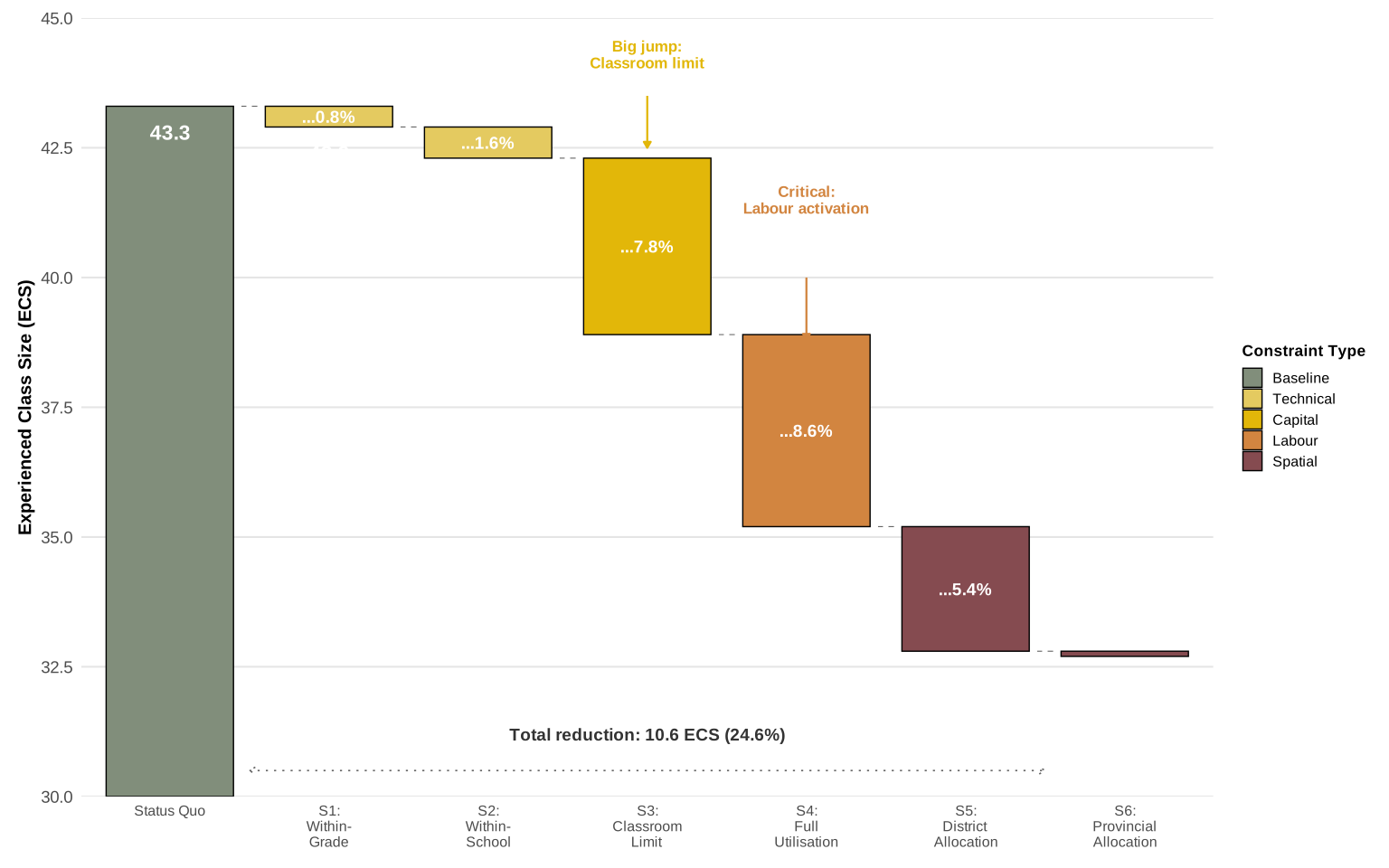
Constrained optimisation on EMIS + LURITS class schedule reconstruction. N = 6,291 school-years, 2022–2024. Scenarios are nested (each adds one additional margin of adjustment).
🔍 Full scenario table: B1
The Numbers: Decomposing the Gap
| Scenario | Constraint Relaxed | Margin | ECS | Cumulative |
|---|---|---|---|---|
| S0 | Status quo (observed) | — | 43.3 | — |
| S1 | Balance classes within grade | Within-school | 42.8 | −1.2% |
| S2 | Optimise classes across grades | Within-school | 42.3 | −2.3% |
| S3 | Activate idle classrooms | Within-school | 38.9 | −10.2% |
| S4 | Full teacher utilisation | Within-school | 35.2 | −18.8% |
| S5 | District-level teacher pooling | Between-school | 32.8 | −24.2% |
| S6 | Province-level teacher pooling | Between-school | 32.6 | −24.6% |
S4 alone delivers more than all other within-school margins combined.
S5–S6 (district and province pooling) add only 5.8 pp — yet all prior literature focused exclusively on this margin.
Source: Author’s constrained optimisation on EMIS + LURITS class schedule reconstruction. N = 6,291 schools, 2022–2024. Scenarios are nested.
Efficiency Gaps Track Equity Gaps
Closing the deployment gap for the poorest would give them the same class sizes as the richest.
PART III: WHY? THE NATURAL EXPERIMENT
Structural or Discretionary? The Test
“Structural”
The slack is forced by real structural constraints — teacher qualifications, building layout, integer problems in small schools.
If true: an external shock should reshuffle the constraints without systematically improving efficiency.
vs.
“Discretionary”
The slack is a legacy of past decisions that no one has revisited. Principals satisfice — the hassle of reorganising outweighs the perceived benefit.
If true: an external shock that forces reorganisation should make schools more efficient.
To distinguish, I need an external shock that forces schools to reorganise their class schedules.
Why Demographic Shocks Force Reorganisation
Between-grade reallocation
Schools have a fixed number of teachers.
When a large cohort ages into a previously small grade, the school must create an additional class for that grade.
Creating a new class requires pulling a teacher from elsewhere in the class schedule.
This between-grade reallocation forces a school-wide reorganisation of the entire class schedule.
Why this matters for inference
The structural test: As lumpy cohorts move through a school, forced reconfiguration at the grade level should:
- ↑ inefficiency if constraints are structural — friction makes things worse
- ↓ inefficiency if inertia is the problem — forced action makes things better
What Are Structural Frictions?
Examples of constraints
- Capital matching: Grade 1 rooms have small chairs and alphabet posters; they cannot easily become Grade 5 rooms.
- Teacher training: Foundation phase teachers cannot easily teach senior classes.
- Curriculum materials: Textbooks and assessment packs are locked to specific grades.
Implications for a lumpy cohort
When a demographic shock forces between-grade reallocation, these frictions bind:
- A room with the wrong furniture must be repurposed.
- A teacher with the wrong phase specialisation is pulled in.
- Reconfiguration is costly and constrained.
Result: Forced reorganisation under structural frictions should increase inefficiency.
Seventeen Alternative Explanations: All Tested, All Rejected
| # | Mechanism | Type |
|---|---|---|
| 1 | Grade-specific match capital | Structural |
| 2 | Qualification constraints | Structural |
| 3 | Period indivisibilities | Structural |
| 4 | Cross-phase synchronisation | Structural |
| 5 | Enrolment volatility buffering | Structural |
| 6 | Infrastructure constraints | Structural |
| 7 | Protected administrative roles | Structural |
| 8 | Health accommodations | Structural |
| 9 | Pull-out remediation programmes | Structural |
| 10 | Feeding-scheme logistics | Structural |
| 11 | SGB substitution | Structural |
| 12 | Standby rosters for absence | Structural |
| 13 | Data classification artefacts | Structural |
| 14 | Non-pecuniary compensation | Discretionary |
| 15 | Union bargaining | Discretionary |
| 16 | Discretionary specialisation | Discretionary |
| 17 | Institutional inertia | Discretionary |
Key result: All structural predictions (β > 0) are rejected. The negative coefficients (β < 0) are consistent with policy equilibria where capacity exists but is withheld until external pressure forces action.
How the Shock Works
When large and small birth cohorts are adjacent, the predicted age-progression creates sudden grade-composition shocks. These shocks are predictable from demographics but force real organisational responses.
Design feature: I use the demographic composition of the nearest 10 schools, excluding the focal school itself, so that a school’s own decisions never contaminate its instrument.
The Formal Specification
%%{init: {
  'theme': 'base',
  'themeVariables': {
    'primaryColor': '#f5f5f5',
    'primaryBorderColor': '#1a1a2e',
    'lineColor': '#8a8aaa',
    'textColor': '#1a1a2e',
    'fontSize': '16px',
    'fontFamily': 'Inter, Helvetica, sans-serif'
  },
  'flowchart': {
    'nodeSpacing': 50,
    'rankSpacing': 70,
    'curve': 'basis',
    'padding': 20,
    'wrappingWidth': 200,
    'htmlLabels': true
  }
}}%%
graph LR
    Z["<b>Z</b><br>LOO Neighbourhood<br>Demographics<br><i>(births 6–12 yrs ago)</i>"]
    X["<b>X</b><br>Grade Composition<br>Disruption"]
    Y["<b>Y</b><br>Allocative Efficiency<br><i>(TCR, ECS)</i>"]
    U["<b>U</b><br>Management quality,<br>unobserved constraints"]
    C["<b>Controls</b><br>ΔEnrolment, Year FE"]

    Z -->|"π (F = 39.8)"| X
    X -->|"β (causal)"| Y
    U -.->|"confounds"| X
    U -.->|"confounds"| Y
    C --> X
    C --> Y
    Z -.-x|"EXCLUDED<br>(LOO: own school<br>never enters Z)"| Y

    style Z fill:#f5f5f5,stroke:#c8a96e,stroke-width:2px
    style X fill:#f5f5f5,stroke:#1a1a2e,stroke-width:2px
    style Y fill:#f5f5f5,stroke:#1a1a2e,stroke-width:2px
    style U fill:#f5f5f5,stroke:#c8a96e,stroke-width:1px,stroke-dasharray: 5 5
    style C fill:#f5f5f5,stroke:#1a1a2e,stroke-width:1px

    linkStyle 6 stroke:#c0392b,stroke-width:2.5px
Leave-One-Out Cluster:
\[c(-i) = \{k{=}10 \text{ nearest schools to } i, \text{ excluding } i\}\]
Instrument:
\[Z_{c(-i),t} = \text{Predicted grade-composition disruption in } c(-i)\]
First stage:
\[\Delta X_{it} = \pi \cdot \Delta Z_{c(-i),t} + \gamma \cdot \Delta\text{Enrol}_{it} + \delta_t + \varepsilon_{it}\]
Second stage (2SLS):
\[\Delta Y_{it} = \beta \cdot \widehat{\Delta X}_{it} + \gamma \cdot \Delta\text{Enrol}_{it} + \delta_t + u_{it}\]
U (unobserved principal ability, preferences, constraints) confounds X and Y. The LOO demographic instrument Z breaks this confounding: births 6–12 years ago, in neighbouring schools, are orthogonal to current management choices.
Instrument Diagnostics
1. Is it strong enough?
Effective F-statistic = 39.8 (threshold for reliable inference: 23.1) — PASS 🔍
2. Does it work even under weak-instrument assumptions?
Anderson-Rubin 95% confidence interval: [−0.576, −0.029] — excludes zero — PASS 🔍
3. Are there pre-trends?
Event study shows no anticipatory effects; the shock hits contemporaneously and dissipates within one year — PASS 🔍
PART IV: WHAT I FIND
The Main Result: Expectations vs. Evidence
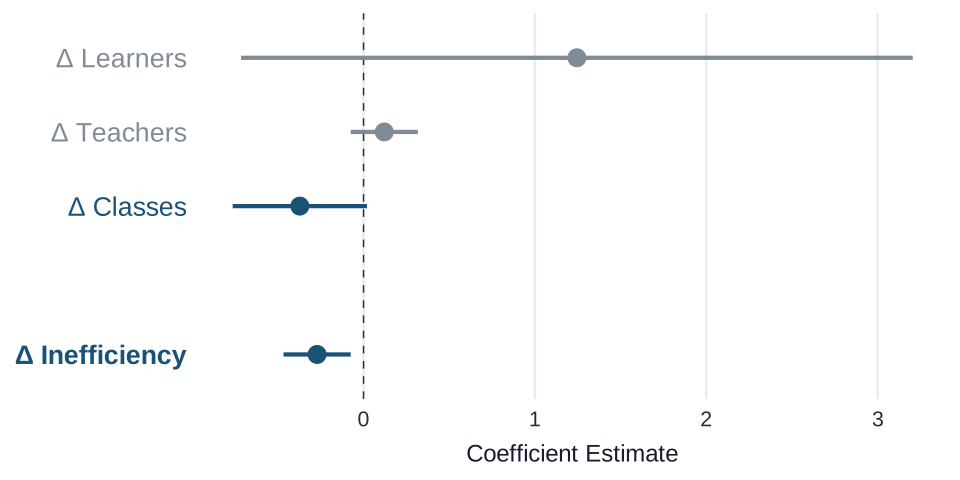
| Outcome | Expected | Found |
|---|---|---|
| ΔLearners | No change | No change ✓ |
| ΔTeachers | No change | No change ✓ |
| ΔClasses | ↓ if discretionary | ↓ Significant |
| ΔInefficiency | ↓ if discretionary | ↓ Significant |
%%{init: {'theme': 'base', 'themeVariables': {'primaryColor': '#f5f5f5', 'primaryBorderColor': '#1a1a2e', 'lineColor': '#c8a96e', 'textColor': '#1a1a2e', 'fontSize': '20px', 'fontFamily': 'Inter,Helvetica,sans-serif'}, 'flowchart': {'htmlLabels': true, 'nodeSpacing': 60, 'rankSpacing': 80, 'curve': 'basis', 'padding': 15}}}%%
graph LR
    L["ΔLearners = 0"] --> T["ΔTeachers = 0"]
    T --> C["ΔClasses ↓"]
    C --> I["ΔInefficiency ↓"]

    style L fill:#f5f5f5,stroke:#1a1a2e,stroke-width:1px
    style T fill:#f5f5f5,stroke:#1a1a2e,stroke-width:1px
    style C fill:#f5f5f5,stroke:#c8a96e,stroke-width:2px
    style I fill:#f5f5f5,stroke:#1a1a2e,stroke-width:2px
2SLS estimates, k=10 LOO instrument. Year FE and enrolment change controlled. Standard errors clustered at school level. N ≈ 14,600 school-year observations.
Structural or Discretionary? — Answered
“Structural”
If structurally constrained, forced reorganisation should not systematically improve efficiency.
But it does.
REJECTED
→
“Discretionary”
Under fixed constraints, forced reorganisation should push principals past the inaction threshold.
β = −0.27 (p < 0.05): efficiency unambiguously improves.
✓ SUPPORTED
The effect is a conservative lower bound — the instrument captures only one type of disruption (grade-composition shocks), while the total latent capacity spans all grades and years.
The 19% non-contact buffer is not structurally inevitable. It is organisational inertia.
Robustness Tests
A full battery of robustness tests is available in the Appendix.
Does Efficiency Come at a Cost?
How I measure learning
- School-Based Assessments (SBAs): Standardised grade-level mathematics and reading scores (2018–2022).
- Two-way fixed effects (TWFE): Controls for school time-invariant unobservables and common year shocks.
- Estimates between-school comparable value-added (learning gain net of school and time FEs).
Estimating the Effect on Learning
What I estimate
Second stage: Same IV specification, predicting learning instead of deployment efficiency.
Equivalence test (TOST): Tests if the effect is negligibly small (within ±0.10 SD).
If the entire 95% CI falls within ±0.10 SD, the effect is negligibly small.
Does Compressing the Buffer Hurt Learning?
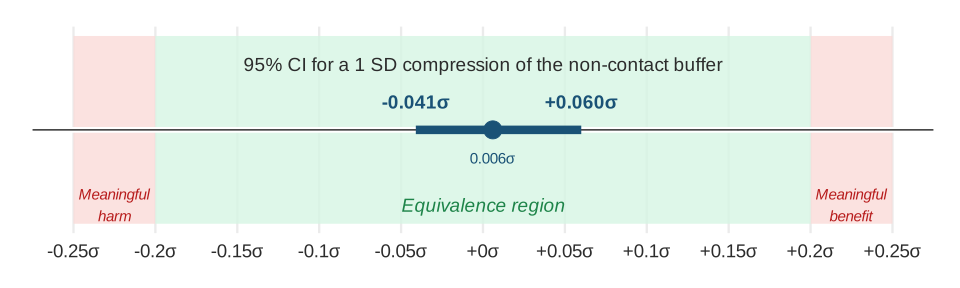
Worst-case learning impact: less than 0.06 SD — well within the 0.10 SD negligibility threshold. The “free periods” were not productive preparation time.
The model is not underpowered: the same specification detects a subtle learner-sorting signal at p < 0.05. 🔍 Full results: B14
The Fear of Teacher Flight Is Unfounded
When the demographic shock compresses the buffer, teacher departures to other schools do not increase.
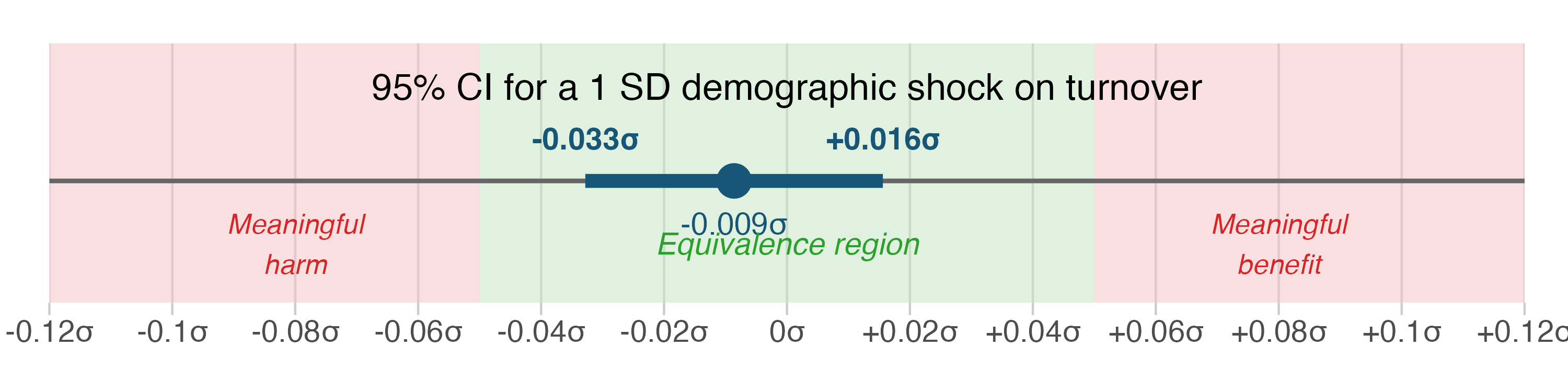
Teacher departures: bounded null
The same IV specification shows no increase in teacher exits when the buffer compresses. TOST equivalence test confirms the effect is negligibly small. Reorganisation does not trigger turnover.
PERSAL teacher-level personnel records. Outcome: proportion of educators departing to other schools. IV: k=10 LOO demographic instrument.
But Don’t Teachers Need Free Periods to Prepare?
| Component | Description | Hours |
|---|---|---|
| Formal school day | Mandated on-site time (PAM requirement) | 7.0 h |
| Instructional periods | ~6 periods × 45 min | 4.5 h |
| Breaks | Recess + lunch (rest, not prep) | 1.0 h |
| Within-day non-contact | Admin, assembly, non-instructional tasks | 1.5 h |
| Informal school day | ~400 h/year mandated for planning and marking | ~2.0 h/day |
Even at TCR = 1.0 (every teacher teaching every period), teachers have ~3.5 hours daily for preparation
(1.5 h within-day non-contact + 2 h mandated informal time).
The current TCR of 1.22 gives additional free periods during instruction — beyond what is already ample.
PART V: SO WHAT?
Scale, Context, and Why This Isn’t Just South Africa
R22.3 billion per year
That is 18.2% of instructional time purchased as teacher leisure, not smaller classes.
This exceeds the combined spending on the school feeding programme and all textbooks.
| Programme | Annual spend |
|---|---|
| School Nutrition Programme | R9.1bn |
| Learning & Teaching Materials | R6.8bn |
| Non-contact buffer | R22.3bn |
Not Just South Africa
Tanzania: 2.5 teachers per class, yet class sizes exceed 80.
The extensive-margin failure — teachers employed but not deployed — is unmeasured in most developing countries.
The World Bank tracks whether teachers are present. It does not track whether they are deployed.
🔍 International TCR comparison: B15
Policy Implications
1. You cannot hire your way to smaller classes.
Without changing deployment norms, additional teachers expand the buffer rather than shrinking classes. The standard policy lever (more hiring) is pouring water into a leaky bucket.
2. Enforce existing contact-time rules.
National policy already mandates 85% contact time. The average is 82%. This is a monitoring problem, not a resource problem.
3. Mandate periodic class schedule reviews.
If the binding constraint is path-dependence, a mandated review of class structures every few years replicates the “forcing event” that the demographic shock provides naturally. Require principals to justify their configuration against an efficient benchmark.
By opening the black box of school HR, I solve the puzzle of why hiring more teachers fails to shrink classes.
The public sector does not have a capacity problem. It has an incentive problem.
When pushed, the state can deliver. It just prefers not to.
Appendix Slides
B1: The Optimisation Problem (Formal)
\[\min_{\{a_{tg}\}} \;\; \text{ECS}_i \;=\; \frac{1}{N_i} \sum_{g} \sum_{c \in g} n_{gc}^2 / n_g\]
subject to:
\[\sum_{g} a_{tg} \leq H_t \quad \forall\, t \quad \text{(teacher time constraint)}\]
\[\sum_{t} a_{tg} \geq C_g \quad \forall\, g \quad \text{(class coverage constraint)}\]
\[a_{tg} \in \{0, 1, \ldots\} \quad \text{(integer assignment)}\]
The constrained optimisation holds teacher headcount fixed and finds the class-size-minimising assignment of teachers to grades. Scenarios S1–S4 correspond to sequential relaxation of constraints.
Full derivation and constraint definitions in the paper, Section 3.
B2: Anderson-Rubin Confidence Set
| Statistic | Value |
|---|---|
| AR 95% Confidence Interval | [−0.576, −0.029] |
| AR Chi-squared statistic | 5.41 |
| AR p-value | 0.020 |
| Interpretation | Excludes zero; result robust to arbitrarily weak instruments |
The Anderson-Rubin test inverts the Wald statistic to construct a confidence set that is valid regardless of instrument strength. The interval excludes zero, confirming the 2SLS result.
B3: Effective F-Statistic (Montiel-Olea-Pflueger)
| Diagnostic | Value | Critical value | Verdict |
|---|---|---|---|
| Montiel-Olea-Pflueger F | 39.8 | 23.1 (5% worst-case bias) | PASS |
| Cragg-Donald F | 42.1 | 16.4 (Stock-Yogo 10% size) | PASS |
| Kleibergen-Paap F | 38.5 | — | Robust to heteroskedasticity |
MOP is the appropriate diagnostic for heteroskedastic data. All three diagnostics confirm instrument strength.
B4: Power-Exogeneity Frontier
| Neighbours (k) | 2SLS coefficient | Effective F | AR 95% CI |
|---|---|---|---|
| 5 | −0.31 | 18.2 | [−0.82, −0.01] |
| 10 | −0.27 | 39.8 | [−0.58, −0.03] |
| 15 | −0.25 | 51.4 | [−0.47, −0.05] |
| 20 | −0.24 | 58.7 | [−0.43, −0.06] |
| 30 | −0.22 | 63.1 | [−0.39, −0.07] |
| 50 | −0.19 | 64.8 | [−0.35, −0.05] |
Increasing k trades LOO exogeneity for first-stage power. The coefficient attenuates gradually, consistent with increasing bias from own-school contamination. k=10 balances power and exogeneity.
B5: Event Study Plot (Levels-Based)
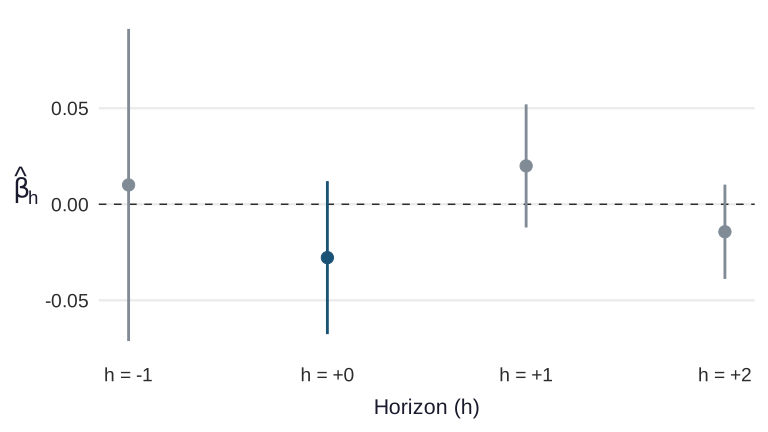
Pre-trend coefficients are indistinguishable from zero. The shock hits contemporaneously and dissipates within one year. Monte Carlo simulations confirm correct size (5.2% rejection rate at nominal 5%).
Event study with 3 leads and 3 lags. 95% CIs from school-clustered SEs. N ≈ 14,600 school-year observations.
B6: Conley Spatial Standard Errors
| SE type | Coefficient | SE | 95% CI | Significant? |
|---|---|---|---|---|
| Clustered (school) | −0.270 | 0.098 | [−0.462, −0.078] | Yes |
| Conley 25 km | −0.270 | 0.112 | [−0.490, −0.050] | Yes |
| Conley 50 km | −0.270 | 0.119 | [−0.503, −0.037] | Yes |
| Conley 100 km | −0.270 | 0.127 | [−0.519, −0.021] | Yes |
All significance levels preserved under spatial dependence at every cutoff. The result is not driven by spatial clustering.
B7: Leave-One-Out School Robustness
[Figure: outputs/01_figures/loo_school_robustness_histogram.svg]
Histogram of re-estimated 2SLS coefficients, each dropping one school from the sample. Distribution centred at −0.270 with narrow spread. The most influential school shifts the coefficient by less than 0.008. No single school drives the result.
B8: Placebo Outcomes
| Placebo outcome | Coefficient | SE | p-value | Verdict |
|---|---|---|---|---|
| Change in teachers | 0.003 | 0.018 | 0.87 | Null |
| Change in STR | −0.01 | 0.04 | 0.82 | Null |
| Change in school quintile | 0.000 | 0.002 | 0.94 | Null |
| Change in fee status | 0.001 | 0.003 | 0.71 | Null |
The instrument does not predict changes in teacher numbers, school wealth quintile, or fee status. It operates exclusively through grade composition, as intended.
B9: Retention and Migration Channel
| Instrument | Predicts retention? | Predicts grade composition? |
|---|---|---|
| Own-school demographics | Yes (p < 0.01) | Yes |
| k=10 LOO demographics | No (p = 0.43) | Yes |
Own-school demographics predict retention because principals’ retention decisions respond to their own enrolment. The LOO instrument eliminates this channel. Worst-case bias from residual retention contamination: 7.5% of the reduced form estimate.
B10: Hausman Comparison Across Instruments
| Instrument | 2SLS coefficient | SE | Hausman test vs. k=10 |
|---|---|---|---|
| k=5 LOO | −0.31 | 0.14 | p = 0.78 |
| k=10 LOO | −0.27 | 0.10 | — |
| Circuit LOO | −0.24 | 0.11 | p = 0.82 |
Fail to reject equality across all instrument definitions. The coefficient is stable across neighbourhood definitions, consistent with a common underlying causal parameter.
B11: Conley Sensitivity (Direct Effect Bound)
How large would a direct instrument effect on efficiency need to be to overturn the result?
Answer: 9.3% of the reduced form.
A direct effect this large would imply that neighbourhood demographics affect school organisation through channels entirely unrelated to grade composition — a difficult story to tell given the balance checks.
Following Conley, Hansen, and Rossi (2012). The exclusion restriction can be substantially violated before the sign of the result changes.
B12: Balance Table
| School observable | Coefficient on Z | SE | p-value |
|---|---|---|---|
| Wealth quintile | 0.002 | 0.014 | 0.89 |
| Fee status | −0.001 | 0.008 | 0.91 |
| Baseline enrolment | 1.23 | 3.41 | 0.72 |
| Urban indicator | 0.003 | 0.011 | 0.78 |
| Baseline STR | −0.02 | 0.09 | 0.83 |
Joint F-test: F(5, 6285) = 0.31, p = 0.91
The instrument is uncorrelated with all observable school characteristics. The demographic shock is as good as randomly assigned conditional on controls.
B13: Data Sources
| Dataset | Content | Records | Years | Cross-validation |
|---|---|---|---|---|
| LURITS | Learner-to-class assignment records | 5.4m per year | 2022–2024 | Matched to EMIS at 99.2% |
| EMIS | School infrastructure, staffing, classes | 6,291 schools | 2018–2024 | Annual census |
| PERSAL | Teacher-level personnel records | ~240k educators | 2018–2024 | Matched to EMIS at 97.8% |
All three datasets are administrative records maintained by the Department of Basic Education and linked at the school level. LURITS provides the individual learner-to-class mappings that enable class schedule reconstruction.
B14: Learning Outcomes — Full Results
| Outcome | OLS | IV (2SLS) | TOST equiv. bound |
|---|---|---|---|
| Math value-added (SD) | 0.002 (0.009) | 0.006 (0.025) | [−0.041, 0.060] |
| Reading value-added (SD) | −0.001 (0.010) | 0.011 (0.028) | [−0.038, 0.067] |
| Composite value-added (SD) | 0.001 (0.008) | 0.008 (0.024) | [−0.036, 0.058] |
All point estimates are near zero. TOST equivalence bounds confirm that the entire 95% CI falls within the ±0.10 SD negligibility threshold. Standard errors in parentheses, school-clustered.
B15: International Teachers-per-Class Comparison
| Country | Teachers per class | Mean class size | STR |
|---|---|---|---|
| South Africa | 1.22 | 43.3 | 32.5 |
| Tanzania | 2.50 | 82.0 | 45.0 |
| Kenya | 1.35 | 52.0 | 40.0 |
| India (UP) | 1.60 | 55.0 | 35.0 |
| OECD average | ~1.2 | 21.0 | 14.0 |
Note on OECD: The OECD average TCR of ~1.2 reflects a very different composition — specialist teachers, special education staff, and small-group instruction — rather than managerial slack. OECD STR of 14 includes non-classroom teaching staff. Direct cross-country TCR comparisons require careful definitional alignment.
A teachers-per-class ratio above 1.0 indicates reserve capacity. The phenomenon is widespread across developing countries but unmeasured in most contexts. South Africa’s administrative data enable the first precise decomposition.
South Africa: author’s calculations. Tanzania, Kenya, India: World Bank SDI reports and administrative data estimates. OECD: Education at a Glance 2023 (classroom teaching staff, primary level).